
Selling Monitoring Under Your Own Brand: How to Build a Productized Offer

Selling monitoring under your own brand means this: you offer uptime monitoring as your own service – under your logo, on your domain, with reports that carry your name – instead of visibly passing through someone else's tool. The difference isn't cosmetic. It decides whether monitoring stays a pass-through cost in your portfolio or becomes a standalone, recurring revenue line. This piece shows how to turn the white-label feature into a sellable offer: packaging, price, brand, and the technical building blocks that turn a feature into a selling point.
Why branded monitoring is a business model
The value of branded monitoring isn't in checking whether a site is reachable – any tool does that. It's in giving your client an ongoing proof of your work that carries your name. Debugging is engineering. Visible uptime is service delivery. That shift is what turns a feature into an offer.
Most providers treat monitoring as an internal tool: they check in the background whether client sites are up and reach out when something breaks. The client never sees it – and pays accordingly, which is to say for nothing. Sell monitoring under your own brand and you invert that: the client gets a status page on your domain, monthly reports with your logo, alerts from your sender address. Invisible insurance becomes a tangible, monthly-proven service.
The business logic underneath is simple. What the client perceives as your work, you can charge for. What disappears into the background, you give away. The white-label layer is the mechanism that creates perception – and perception is the precondition for a price.
The three layers that turn a feature into an offer
A sellable white-label offer stands on three brand layers: the visible surface (domain and logo), the recurring proof of value (reports), and seamless communication (your own sender). Miss one, and the impression that this is your own service starts to crack – and the price cracks with it.
Your own domain and logo
The status page is your offer's storefront. Run it on a foreign URL with a foreign logo, and you're visibly selling someone else's product. Run it on your own subdomain – something like status.youragency.com – with your logo, and it's indistinguishable from something you built. Technically that's a CNAME record. Commercially it's the difference between "reseller" and "provider."
For the client, that first impression is everything: in a crisis, they open a page that carries your name and see the status of their systems. No foreign branding raising the question of why they don't just buy that tool directly.
Branded reports as a monthly proof of value
The most common reason retainers die isn't bad work – it's invisible work. Sooner or later the client wonders: what am I actually paying for? An automated, branded uptime report answers that question before it's asked. Month after month, without you lifting a finger.
A PDF report with your logo showing 99.95% uptime over the month isn't a technical document – it's a selling point on paper. It makes your work measurable, recurring, and attributable to your name. That's exactly what justifies the next invoice.
Your own SMTP relay for a seamless sender
This is where the credible offer separates from the transparent one. Every alert and every report leaves the system as an email. If that email comes from a foreign sender address, the brand illusion collapses at the exact moment it matters – in the client's inbox, in a crisis.
Your own SMTP relay over your domain ensures every message comes from you: your sender, your reputation, your deliverability. For the client, the impression stays seamless. For you, it means your brand holds up in the very place where most white-label setups fall apart. This isn't a technical footnote – it's the layer that protects the price.
How to package and price your offer
The price for branded monitoring follows the value to the client, not what you pay for the tool. Because your cost per monitored site stays predictable, everything you charge above it is margin – and that margin grows with every client instead of working against you. Two models have proven themselves.
Per-client add-on. You charge a fixed monthly amount per monitored site or client, folded into the existing retainer. Simple, transparent, easy to scale. Ideal when your portfolio is made of many similar clients.
Tiered packages. You build two or three tiers with increasing scope – by check interval, channels, and report depth, for example. That gives the client a choice and you an anchor toward the top.
| Tier | Who it's for | Typical contents | Pricing logic |
|---|---|---|---|
| Basic | small clients, one main site | uptime check, branded status page, monthly report | low fixed monthly amount |
| Pro | growing clients with several systems | multiple monitors, alerts across channels, shorter interval | mid amount, clear jump in value |
| Enterprise | regulated or business-critical clients | SLA tracking, escalation chains, SMTP over own domain, priority response | premium, tied to business risk |
The actual numbers depend on your market and positioning. The principle holds: you're selling predictable peace of mind, not monitoring access. Anchor the package to the client's business risk – not to technical metrics – and you lift the price to where the value actually sits.
Why the block pays off even with a small portfolio
The work behind branded monitoring is almost entirely one-time – the revenue comes monthly. That asymmetry is why the offer doesn't wait until you have hundreds of clients to pay off. It works from a handful.
The setup – CNAME for the domain, logo upload, SMTP relay – you do once. After that, every new client carries the same brand layer with no repeated groundwork. A new client means one more monitor and one more line item, not a new project. That's how one-off project money turns into recurring revenue that reliably comes back every month.
For the relationship, the block works as an anchor too: a client who receives your branded report every month and opens your status page in a crisis is a client who churns less often. Visible, ongoing work lowers churn – and a client who stays is the cheapest revenue you have.
Frequently asked questions
What does it mean to sell monitoring under your own brand?
You offer uptime monitoring as your own service – under your logo, on your domain, with reports and emails that carry your name. The client sees your brand, not the tool behind it. That turns monitoring from a passed-through third-party product into a standalone, recurring revenue line in your portfolio.
How much can you charge for branded monitoring?
The value the client sees decides it – not what you pay for the tool. Common models are a monthly add-on per monitored site or a tiered package (Basic, Pro, Enterprise). Because your cost per client stays predictable, the gap between your price and your cost is your margin – and it scales with every new client instead of against you.
Do you need your own domain and logo for this?
For a credible offer, yes. The branded status page runs on your own subdomain (via CNAME), and reports and the dashboard carry your logo. Without that layer, you're visibly selling someone else's tool – with it, you're selling your service. The work behind it is a one-time DNS and upload setup.
Why is an SMTP relay a selling point and not a technical detail?
Because every alert and report email then comes from your domain, not a foreign sender address. That protects your brand in the client's inbox and your deliverability through your own reputation. To the client, the impression stays seamless: everything comes from you. That seamlessness is exactly what justifies the price.
Is this worth it for a small client portfolio?
Yes – especially there. Even with a handful of retainer clients, a monthly monitoring block is the difference between one-off project money and predictable recurring revenue. The setup happens once; the revenue comes back every month. The larger your portfolio grows, the more the block carries.
→ CNAME & SMTP relay: how the white-label is actually wired
You bind the status page through a CNAME record to your own subdomain – your domain points at the monitoring infrastructure, and the client only ever sees your URL. Outbound mail runs through your own SMTP relay: your domain as sender, your reputation, no shared-IP roulette. Both are a one-time setup in the dashboard. After that, every status page, alert, and report carries your brand without you touching a thing for each new client.

Co-Founder of Uptimeify, responsible for all of marketing. He bridges technical development and marketing strategy — from Java, PHP and Shopware plugins to steering digital growth strategies. A certified UX Manager (IHK) and digital-marketing advisor to three non-profit organizations.
More from the blog
Sell monitoring as a service: the playbook for agencies
How to package website monitoring as a paid service with recurring revenue — package, price, retainer, white-label.
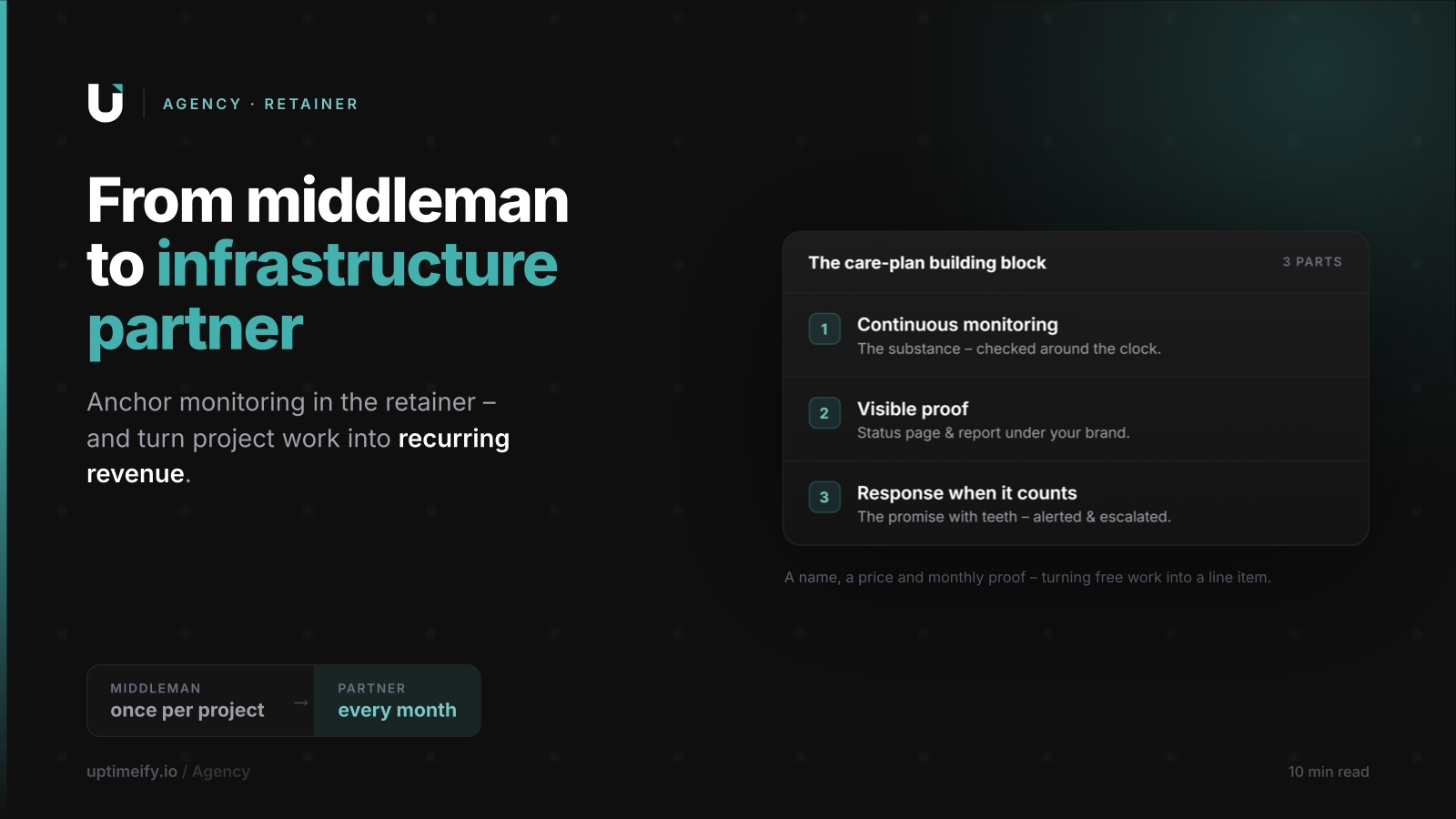
From Middleman to Infrastructure Partner: Anchoring Monitoring in Your Retainer
How agencies anchor monitoring as a fixed retainer building block — with pricing logic, plan components, and a script for the client conversation.
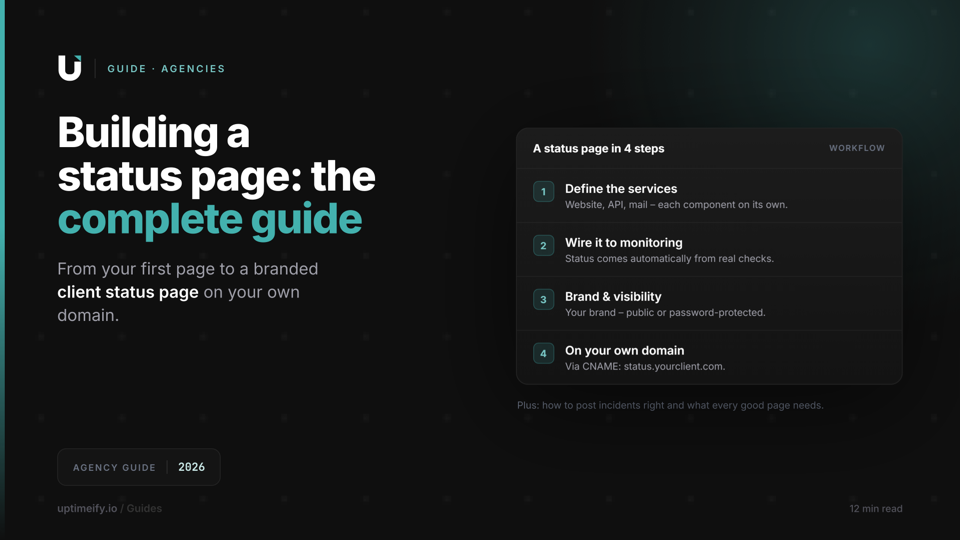
How to Create a Status Page: The Complete Guide for Agencies (2026)
From your first status page to a branded client status page: what to communicate, how to post incidents, and how to run a status page on your own domain.