
SSH Monitoring & Port 22 Auditing. Zero Access Gaps.
Keep eyes on administrative access to every client server, on port 22 or your custom port. Uptimeify catches firewall misconfigurations, server crashes and unexpected connection resets before you're locked out when it counts.
Made and Hosted in the
European Union
GDPR-Compliant Hosting
in Germany
GEO-Redundant Replica
across the EU
Administrative Reachability. Proven around the clock.
Your SSH access is the back door to every server you manage. When it quietly closes, you find out the moment you actually need it. Uptimeify checks on a schedule whether your SSH endpoints still accept management traffic, and flags the outage while you can still act on it.
- Connection audit over a real TCP handshake: so you prove the management port is genuinely reachable, not just pingable.
- Outage detection before the emergency: so you catch server crashes and network failures before you lock yourself out.
- Firewall verification: so one changed security-group rule doesn't silently cut your access.
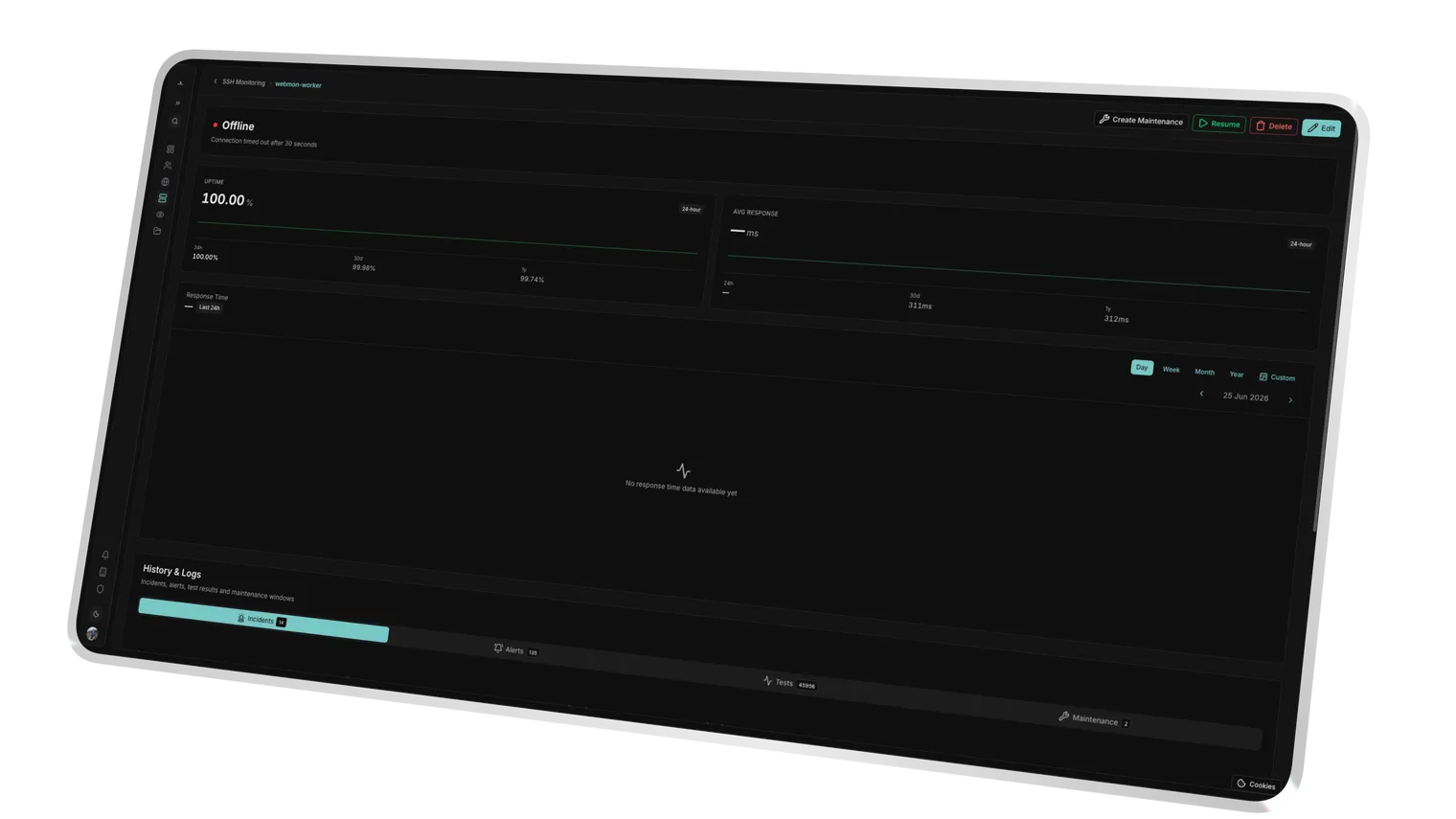
A TCP connection is attempted to the SSH port on every check.
A reachable daemon answers; a crashed service or firewall block does not.
Polled on a fixed interval across the EU network.
Custom Ports and Timeouts. Tuned to how your servers are hardened.
Few hardened servers still listen on the default. Uptimeify watches the port you actually run, with the timeout that fits your link, and no false alarms from a slow connection.
- Port flexibility: so you monitor standard port 22 or any non-standard admin port from your hardening setup.
- Latency & timeout control: so you tell a slow link apart from real unreachability instead of scoring both as an outage.
- Maintenance state: so planned updates pause alerting while monitoring keeps running in the background and the history stays clean.
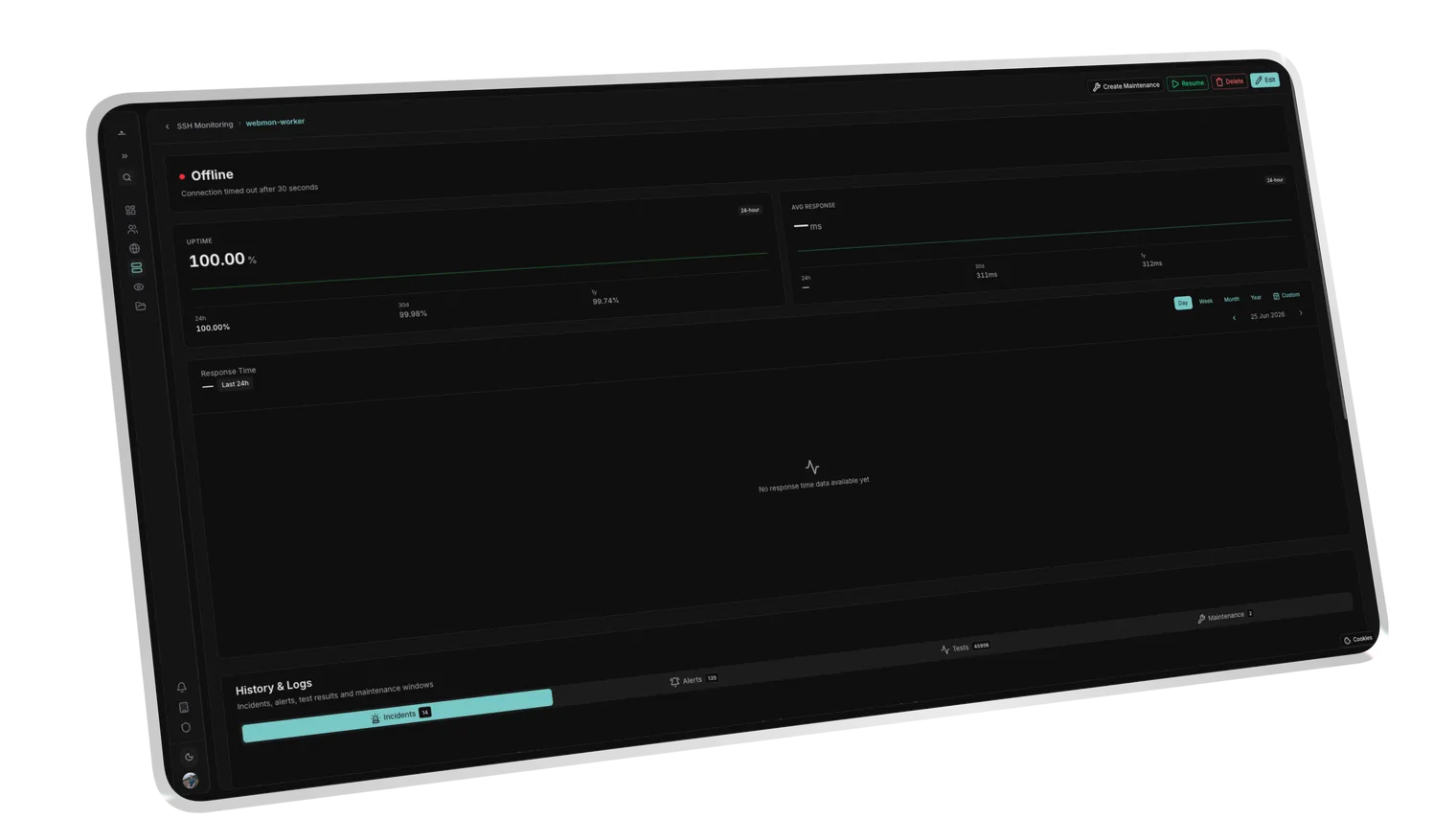
The wait time separates a slow link from a dead service.
Maintenance mode dampens alerts while telemetry keeps recording.
Each host pins its own port and timeout.
Regional Access Guard. Test the door where it's meant to open.
If your server only lets EU IPs through, the monitoring has to come from that same zone. Otherwise you're testing an allowlist that never applies to the probing node. Uptimeify lets you pin the polling regions and reports every failure with a concrete cause.
- Allowed check countries: so your checks respect your server's IP allowlist and geofencing rules instead of tripping them.
- Distributed probing: so a regional ISP failure doesn't pass for a server outage.
- Diagnostic feedback: so you see at once whether a timeout, a connection refusal or a resolution error is behind it.
Checks run from chosen EU regions to match IP allowlists.
Distributed probes reveal when an ISP fault isolates one region.
A failure is confirmed across nodes before an incident opens.
Success Kit
We don't just monitor. We help you sell.
Every Uptimeify subscription includes access to our Success Kit, a collection of battle-tested resources to turn your monitoring into a profit center.
Service Level Agreement templates to define professional boundaries with your clients.
Find the sweet spot for your care plans. Calculate margins based on check frequency and support hours.
Powerpoint Templates that explain 24/7 monitoring to non-technical clients. Close more retainers.
Use automated reports to proactively communicate value, so clients never ask what they're paying for.
Ready to turn monitoring into a profit center?
Claim your Success Kit and start scaling today.
Frequently Asked Questions
On your check interval, Uptimeify opens a real TCP connection to port 22 (or your custom port) and reads whether the handshake is accepted. That gives you a continuous proof of your servers' administrative reachability, so you spot a blocked or crashed access path before you need it in an emergency.
Yes. You set the port to check per monitor: standard port 22 or any custom admin port from a hardened setup. So the monitoring matches your server reality instead of forcing you onto the default.
You pick the allowed check countries yourself, for example EU-only, hosted in Frankfurt and further European nodes without US sub-processors. That keeps your checks aligned with your servers' IP allowlist and geofencing rules, and keeps the data paths inside Europe, which makes your GDPR case easier to argue in client pitches.
Before an SSH monitor flips to "down", independent EU nodes confirm the failure against each other. You're only alerted on consensus. That filters out single routing hiccups and ISP flicker, so you never send an all-clear that's already out of date.
Yes. You log planned work as a maintenance window. Alerting pauses for that period while monitoring keeps running in the background. The status history shows scheduled maintenance instead of a phantom outage, so your client reporting stays clean.
Ready to own administrative access across your whole client base?
Set up SSH monitoring for your entire portfolio in minutes: custom ports, EU polling, and alerts that only fire once the outage is confirmed.