
Reduce Churn with Proactive Monitoring: Report the Outage Before Your Client Notices

The most expensive call in agency life is the one where your client tells you their site has been down for two hours. Not because of the two hours — because of the sentence underneath it: "Why did I have to be the one to notice?" That's the moment the relationship tips. Proactive monitoring flips exactly that moment: you report the outage before your client notices it — and in doing so you go from the vendor who reacts to the agency that thinks ahead. This article is about why that's the most underrated retention lever you have.
The real reason clients leave
Clients rarely cancel over a single outage. They cancel because an outage confirmed something for them: the feeling that they have to look after themselves. At its core, a retainer doesn't sell working hours — it sells peace of mind, the promise "we've got this covered for you." The second a client notices an outage before you do, that promise breaks. The downtime isn't the problem; the realization is: I'm on my own here.
That's the silent churn mechanism. The client says nothing in the moment. They cancel three months later "for budget reasons" — but the root is that afternoon they replaced your monitoring with their own glance at their dead site. Retention isn't decided at contract renewal. It's decided at every incident before it.
Reactive vs. proactive: same outage, two stories
Picture the same ten-minute outage in two worlds.
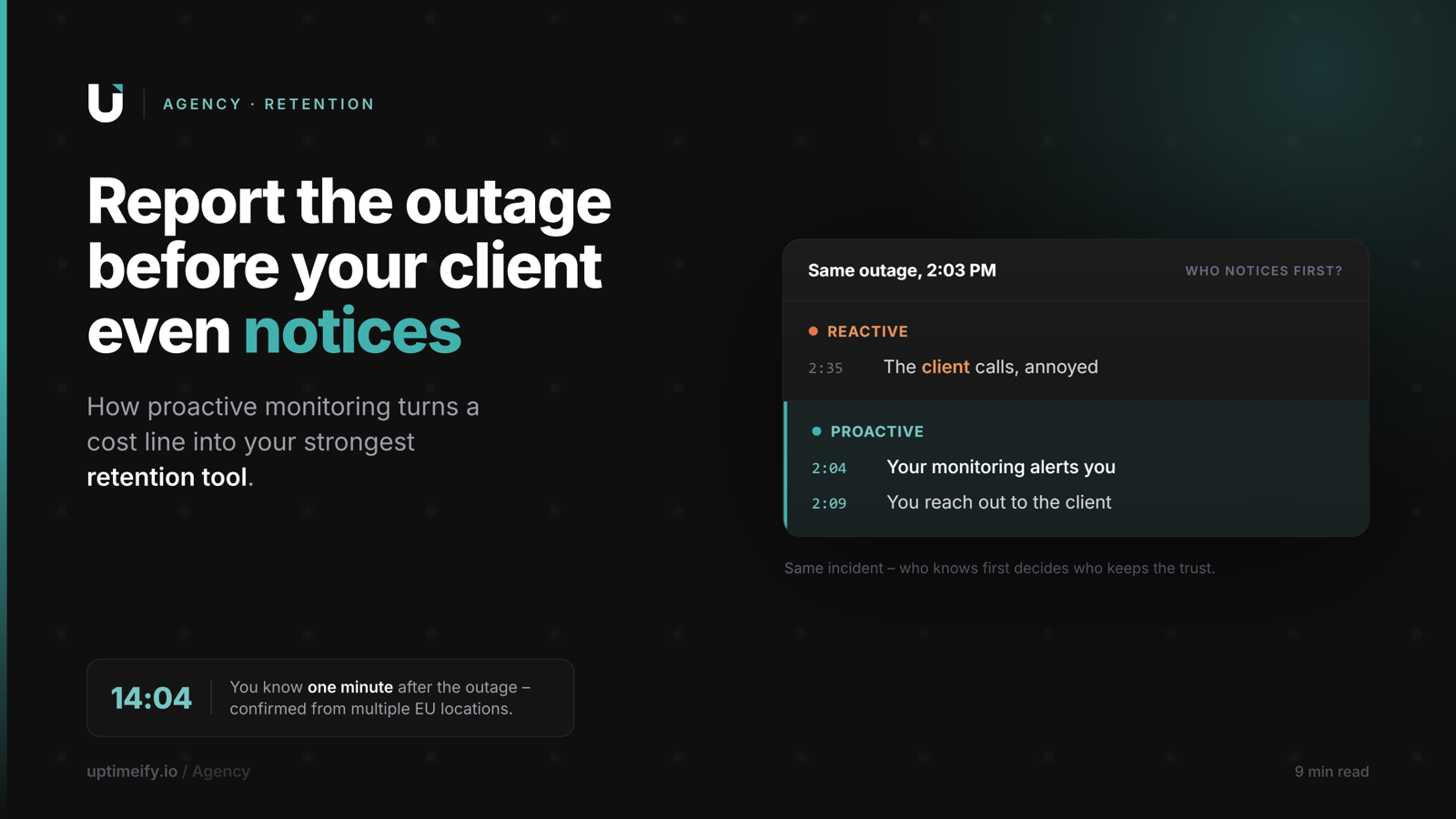
Reactive: your client's site goes down at 2:03 p.m. At 2:20 someone on the client's team notices; at 2:35 a terse email lands in your inbox; at 2:50 you start digging. The outage is long over — but the impression sticks: they didn't catch it. You reacted, and reaction always looks like loss of control.
Proactive: the site goes down at 2:03 p.m. Your monitoring confirms the outage from multiple locations and alerts you at 2:04. At 2:09 you send your client a quick note: "We just detected an issue on your site and we're already on it." At 2:13 the site is back. To the client that isn't a mishap — it's proof that someone is looking after things before they'd have to lift a finger.
Same technical incident, opposite effect on the relationship. The difference isn't the downtime. The difference is who knows first.
Monitoring isn't a cost line — it's your retention tool
In a lot of agencies, monitoring sits on the wrong side of the ledger: a technical obligation, a line in running costs, something you "just need." That framing costs money. Because the same spend is, in truth, one of the most effective retention instruments you have — once you file it correctly.
Do the quick math: keeping an existing client is a fraction of the cost of winning a new one. Every client an unnoticed outage turns into a silent canceller doesn't cost you the monitoring fee — it costs you the entire future retainer. Seen that way, monitoring isn't an expense to minimize. It's an investment in recurring revenue you'd otherwise lose quietly.
The reframe has three layers. Monitoring reduces churn, because it prevents the trust-breaking moments. It justifies your price, because every report and every proactive alert is visible evidence of your work. And it opens upsells, because a client who sees your value in black and white every month is open to the next care-plan step. A cost line becomes a revenue line — same technology, reframed.
Why credibility hinges on precision
There's a fast way to destroy the proactive promise: raise the alarm falsely too often. If you tell your client "your site is down" three times and three times it was just a network hiccup at a single check point, you've taught yourself to ignore your own alerts — and your client to ignore them too. The fourth alert, the real one, lands with a shrug.
That's why the confirmation logic isn't a technical footnote — it's the foundation of your credibility. Uptimeify checks every outage from multiple EU locations before an incident even opens. A brief blip at one node, while the other locations reach the site normally, fires no alert. Only once the outage is confirmed across locations do you get notified. The result: when you message your client, something really is broken — and that's exactly what makes your messages worth taking seriously.
Being proactive doesn't mean reporting more. It means reporting the right thing — every time.
How this works day to day
The proactive promise stands or falls on what happens between "site goes down" and "you reach out to the client." Four building blocks turn the intention into a dependable sequence.
Confirmation before the alert. Every outage is cross-checked from multiple EU locations before an incident opens. That's the precision layer from the previous section — the basis for every alert counting.
The right channel, instantly. Alerts route across up to 29 channels — Slack, Microsoft Teams, SMS, email, webhook and more. The alert reaches you where you already work, instead of aging in an inbox you open in the evening.
Escalation when no one responds. An unacknowledged alert doesn't sit there. It moves on, time-based and multi-step, to the next responsible person. So your proactive promise doesn't depend on whether one specific person happens to be at their desk.
The proof afterward. Every incident and every uptime figure flows into an automated, branded PDF report under your own brand. Today's proactively reported outage becomes documented evidence of your value in the monthly report — a firefight turns into a sales argument.
From outage to proof of trust
The core is simpler than it sounds. Every outage is inevitable — no site runs forever. What you can steer isn't whether something fails, but who knows first. And that one variable decides whether an incident costs trust or builds it.
When your client notices an outage before you do, it's a mishap. When you report it before your client does, it's proof. Same downtime, opposite effect on retention. Proactive monitoring is the tool that tips that variable onto your side for good — turning every inevitable incident into a small, repeated reminder of why your client keeps you.
That's the real reason to monitor client sites. Not to collect uptime numbers, but to be, at every incident, the agency that knows first.
Frequently asked questions
How does monitoring help increase client retention?
Monitoring shifts the moment your client learns about an outage — from "the client calls, angry" to "the agency already caught it and is on it". That role swap is what builds trust: you're not the agency that reacts once there's a fire, you're the one that prevents it. Every proactively reported incident is visible proof of your value — and proof is what keeps a client from cancelling.
What does proactive monitoring mean for an agency?
Proactive means you learn about a problem from your monitoring system, not from your client. Client sites are checked around the clock from multiple locations; when a site goes down, the outage is confirmed first and then automatically escalated to the right responder — before the client's own end users even notice. The opposite is reactive work: you hear about the outage only once the damage is already done.
Is monitoring a cost for agencies, or a revenue lever?
It starts as a line item, but the leverage is elsewhere. Monitoring reduces churn (every retained client is recurring revenue), justifies care plans and retainers with a monthly report, and prevents the silent cancellations that grow out of unnoticed outages. Treated as pure expense it's cheap; treated as a retention and upsell instrument it pays back several times over.
How do you avoid false alarms when monitoring client sites?
False alarms happen when a single check point reads a brief network blip as an outage. Uptimeify confirms every outage from multiple EU locations before an incident opens and alerts fire. A blip at one node triggers no alert. That protects your credibility: when you alert your client, something really is broken — and that's exactly what makes your messages worth taking seriously.
What happens if no one responds to an outage alert?
That's what escalation is for. In Uptimeify an unacknowledged alert moves on, time-based and multi-step, to the next responder — across up to 29 channels like Slack, Teams, SMS or webhook. So no outage sits unhandled just because one person happened to be away from their desk. For your client, that means there's always someone who responds.

Co-Founder of Uptimeify, responsible for all of marketing. He bridges technical development and marketing strategy — from Java, PHP and Shopware plugins to steering digital growth strategies. A certified UX Manager (IHK) and digital-marketing advisor to three non-profit organizations.
More from the blog
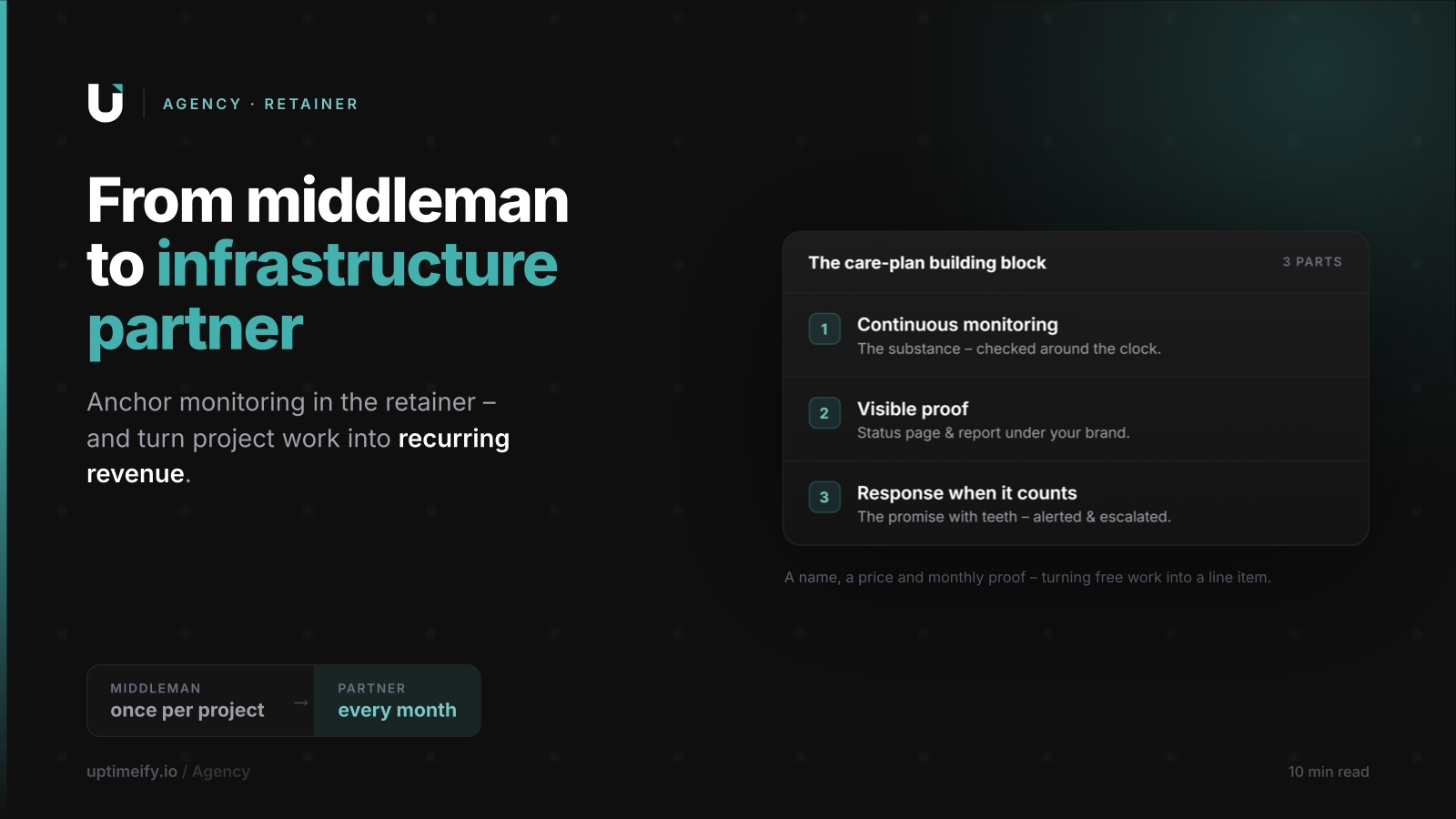
From Middleman to Infrastructure Partner: Anchoring Monitoring in Your Retainer
How agencies anchor monitoring as a fixed retainer building block — with pricing logic, plan components, and a script for the client conversation.
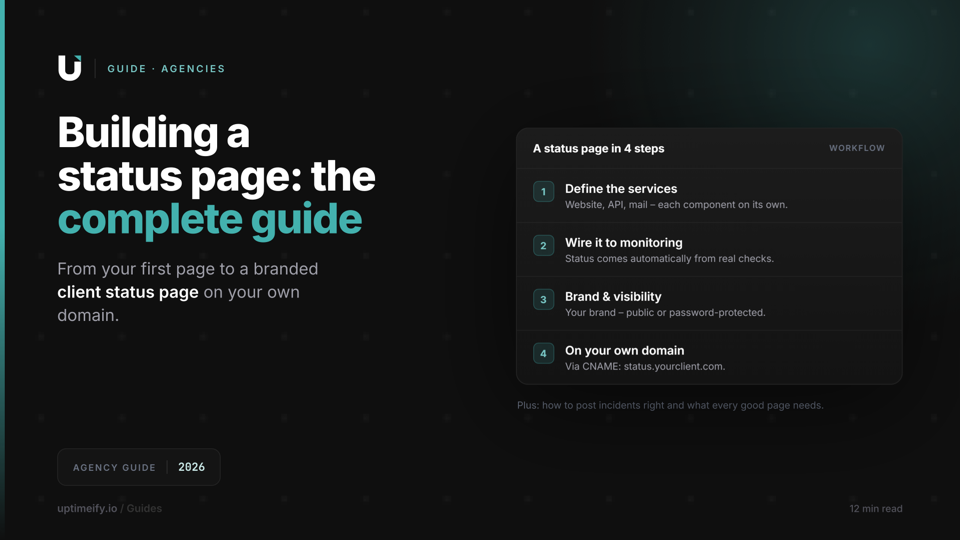
How to Create a Status Page: The Complete Guide for Agencies (2026)
From your first status page to a branded client status page: what to communicate, how to post incidents, and how to run a status page on your own domain.
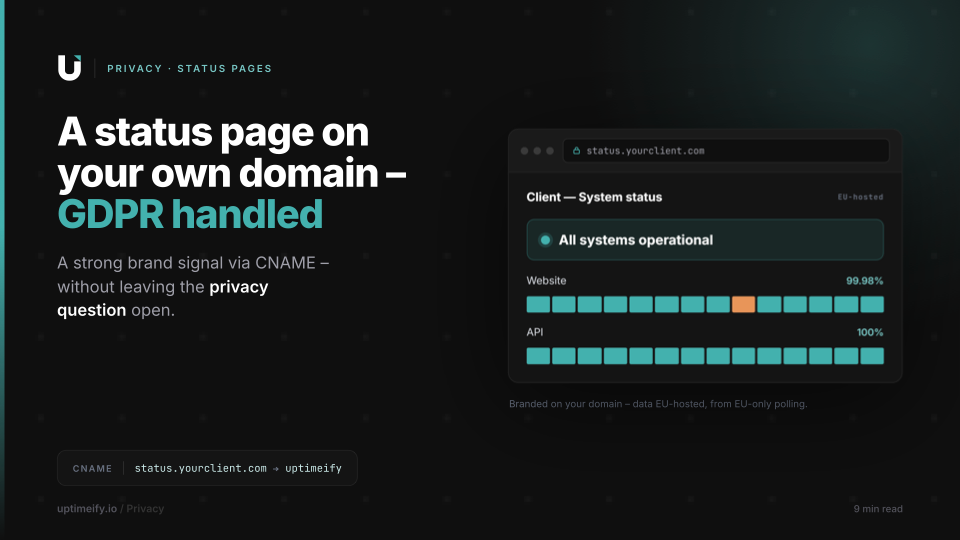
Status Pages on Your Own Domain & GDPR: What Agencies Should Know
How to run a status page on your own domain via CNAME, where the data sits, and what to communicate cleanly under GDPR — the factual guide for agencies.