
Monitoring Without US Sub-Processors: The Advantage in B2B and Public-Sector Pitches

For many MSPs, the hardest moment in a tender isn't price or scope — it's the data-protection annex: the list of sub-processors. A bank or public-sector buyer reads it to the last entry, and the moment a US provider that processes data appears there, a review marathon begins that can delay or topple an award. Monitoring whose data chain runs entirely without US sub-processors takes exactly that friction point out of the pitch. This article explains, factually, why that's an advantage, how to prove it — and where the honest limit of the claim lies.
Why the sub-processor list decides the regulated pitch
In an ordinary B2B sale, the sub-processor list is a formality. In the regulated world — banks, insurers, public authorities — it's an object of review. These buyers carry their own compliance obligations, which they pass down to their providers: work for a public authority, and you have to show that the tools you use meet the requirements too. The review therefore doesn't stop at your agency — it runs all the way down the chain, to the provider that actually processes the data at the very end.
For you as an MSP, that means your monitoring tool isn't an internal detail — it's part of what the buyer assesses. If their chain contains a sub-processor that raises questions, those questions become your questions. And the most laborious of them is always the same: does the data leave the European legal area?
The third-country transfer — explained calmly
The term everything turns on is the third-country transfer: any processing of personal or attributable data outside the European Economic Area. It isn't categorically forbidden. But it's the point where a data-protection assessment grows from one page to ten.
Once data leaves the EU, you need a viable legal basis for the transfer — usually standard contractual clauses (SCCs). Since the relevant European court decisions, those alone are no longer enough: you also need a transfer impact assessment examining whether the destination country — say the US under the CLOUD Act — allows government access that undermines the European level of protection. If that assessment turns out unfavorably, additional technical and organizational measures must apply, or the transfer doesn't hold.
For a regulated buyer, this mechanism isn't a theoretical construct — it's lived risk. Every third-country transfer in the chain is something they have to document, defend, and, if challenged, justify to a supervisory authority. That's why many tenders prefer — and require — solutions where that transfer never arises in the first place. Not because a US transfer is always unlawful, but because its absence is simply the smaller risk.
The advantage: a monitoring chain that stays in the EU
Here's the concrete wedge for regulated MSPs. When the entire chain that processes your monitoring data sits within the EU, no third-country transfer arises — and the most complex chapter of the data-protection assessment falls away entirely. A multi-page review becomes a short, verifiable statement.
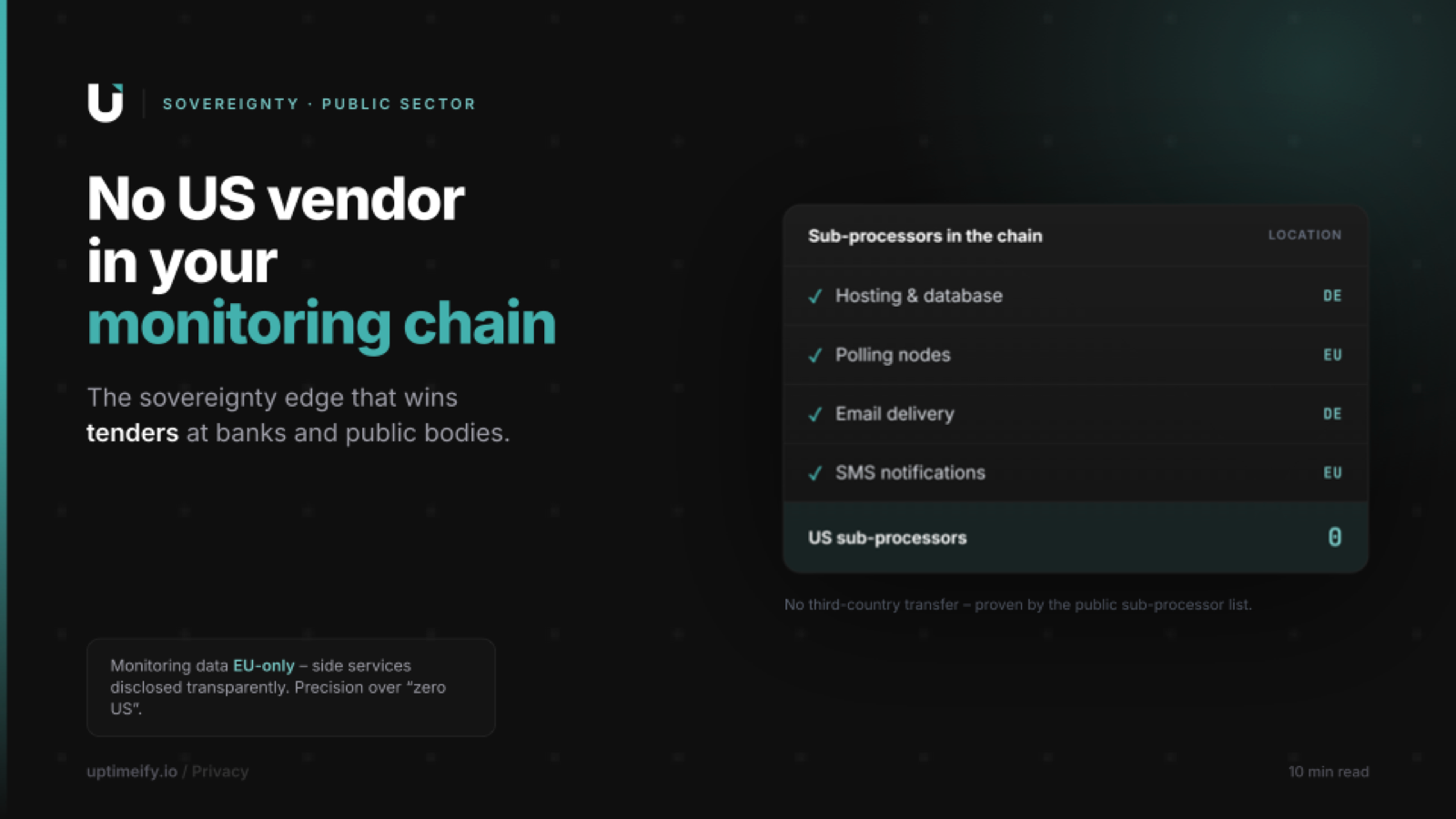
At Uptimeify, this monitoring chain is exactly that: EU-only. The providers that process monitoring data — hosting, the locations of the checking nodes, the email and SMS delivery for notifications — all sit in the EU: in Germany, France, and the Netherlands. The core infrastructure is hosted exclusively in the EU, and polling runs exclusively from European locations (two in Germany — Nuremberg and Falkenstein — plus Zurich, Prague, Warsaw, Milan, and Helsinki). The data the buyer cares about — which URL was checked when, with what result, who was alerted — never leaves the European legal area.
For your pitch, that's a double win. You satisfy a requirement that purely US-based tools regularly fail in regulated tenders. And you shorten the buyer's data-protection assessment instead of lengthening it — which turns you from a supplicant clearing a hurdle into a provider who takes work off their plate.
Staying honest: saying "without US sub-processors" the right way
This is exactly where a defensible argument parts ways with one that shatters on first review. The temptation in a pitch is to claim "completely without US providers." That's almost never true — and a data protection officer looking closely will find the gap. The precise, defensible statement is narrower and therefore stronger: no US sub-processor processes monitoring data.
The difference is purpose. Nearly every company uses services for side functions that sit in the US or belong to US corporations — consent-based website analytics on the public marketing site, code hosting for development, internal team communication, mailboxes. These touch no monitoring data. Where they have a US nexus, they run under recognized safeguards like the EU-US Data Privacy Framework. So the honest sentence isn't "zero US" — it's: the monitoring-data chain is EU-only, and everything outside that chain is transparently disclosed.
That sobriety isn't a concession — it's the core of the persuasiveness. A regulated buyer has met plenty of providers who claim sovereignty and fold under a follow-up question. Naming your own limit unprompted — "this is EU-only, here we use US services under the DPF for side purposes" — reads as audited rather than advertised. Precision beats superlative, especially with the people who have to verify it.
The proof beats the claim
In a regulated setting, an assurance is worth only as much as its evidence. A buyer who has to satisfy their own oversight can't rely on a promise made in a sales call — they need a document they can file and produce if challenged. That's precisely why transparency isn't a nice-to-have but the actual lever.
The strongest proof is a public sub-processor list that states three things for each provider: who it is, where it sits, and whether it processes monitoring data. Uptimeify maintains such a list publicly and marks explicitly, for every entry, whether monitoring data is involved — the EU providers in the chain as well as the side services clearly flagged "no monitoring data." Infrastructure changes are additionally logged in a public changelog. That lets your buyer verify the statement themselves, instead of having to take your word for it.
For you as an MSP, that's the practical core of the pitch playbook: you don't have to claim the sovereignty, you link to it. A verifiable source you cite in the proposal answers the hardest data-protection question before it's asked out loud — and signals to the buyer that you understand their review logic.
Sovereignty as a calm selling point
The sovereignty advantage works best when it doesn't sound like a selling point. Regulated buyers are numb to superlatives — "100% secure," "fully GDPR-compliant" are warning signs to them, not assurances. What convinces them is the calm, precise presentation of a verifiable fact: the monitoring data stays in the EU, here's the list, here's the limit of the claim.
That register is also the most honest one. Sovereign monitoring doesn't free you from your own data-protection duties, and it isn't a legal opinion. What it does is precisely bounded: it takes the third-country transfer out of the monitoring chain and makes that fact provable. It promises nothing more — and that's exactly why it delivers on what it promises.
For regulated MSPs, that's the difference between a tool you have to explain and defend in a pitch and one that carries the pitch. The location of your monitoring data isn't a technical side note. It's the argument that decides a tender others fail already in the data-protection annex.
Frequently asked questions
What does monitoring without US sub-processors mean?
It means no US-based provider is involved in processing your monitoring data — the checked URLs, check results, alert contents, and notification recipients. That entire chain stays with EU sub-processors. The precision matters: this is about the monitoring-data chain, not necessarily every single provider a company uses. That clean distinction is exactly what convinces in a regulated pitch.
Why does this matter for bank and public-sector contracts?
Regulated buyers audit the processing chain down to the last sub-processor. The moment a US provider processes monitoring data, questions arise about third-country transfers, the CLOUD Act, and the level of protection — review work that can delay or block an award. Keep the monitoring chain entirely in the EU and that chapter disappears, and you satisfy a requirement US tools regularly fail in tenders.
What is a third-country transfer and why is it a risk?
A third-country transfer is any processing of personal data outside the European Economic Area. It isn't automatically unlawful, but it requires extra safeguards — such as standard contractual clauses and a transfer impact assessment that examines whether government access in the destination country undermines the European level of protection. For regulated buyers, that effort is a risk: review-heavy, contestable, and in many tenders simply excluded outright.
How do I prove to a buyer that the data stays in the EU?
Through a public, up-to-date sub-processor list that states each provider's location and role — and explicitly flags who processes monitoring data and who doesn't. Uptimeify maintains such a list publicly and logs infrastructure changes in a changelog. That turns your assurance from a claim into a verifiable fact the buyer can inspect themselves.
Does sovereign monitoring mean no US providers at all?
No — and that honesty is part of the strength. What matters is the monitoring-data chain, and that sits entirely with EU providers. For side purposes that touch no monitoring data (say consent-based website analytics or internal code hosting), US services may be in use under recognized safeguards like the EU-US Data Privacy Framework. That clean split — monitoring data EU-only, side purposes transparently disclosed — is more defensible than a blanket, likely untenable 'zero US'.

Co-Founder of Uptimeify, responsible for all of marketing. He bridges technical development and marketing strategy — from Java, PHP and Shopware plugins to steering digital growth strategies. A certified UX Manager (IHK) and digital-marketing advisor to three non-profit organizations.
More from the blog
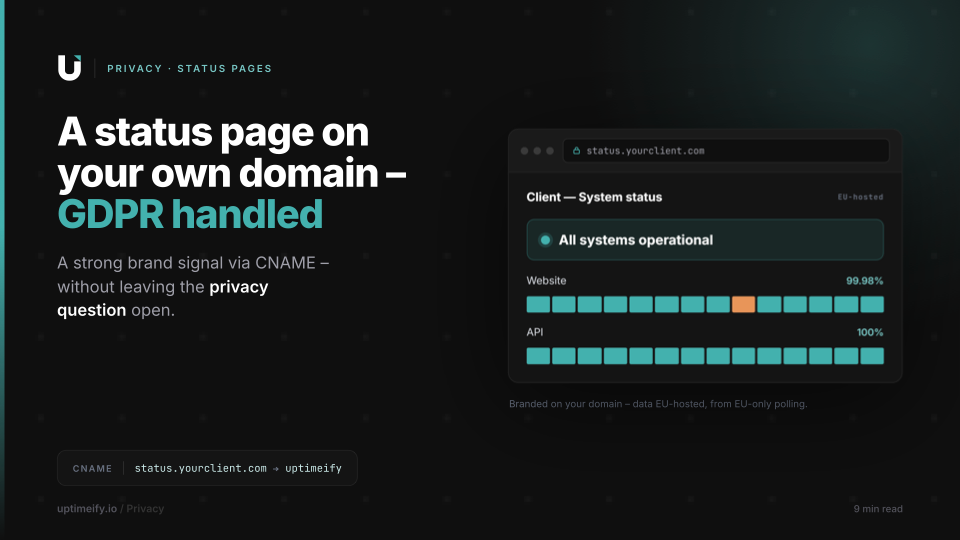
Status Pages on Your Own Domain & GDPR: What Agencies Should Know
How to run a status page on your own domain via CNAME, where the data sits, and what to communicate cleanly under GDPR — the factual guide for agencies.
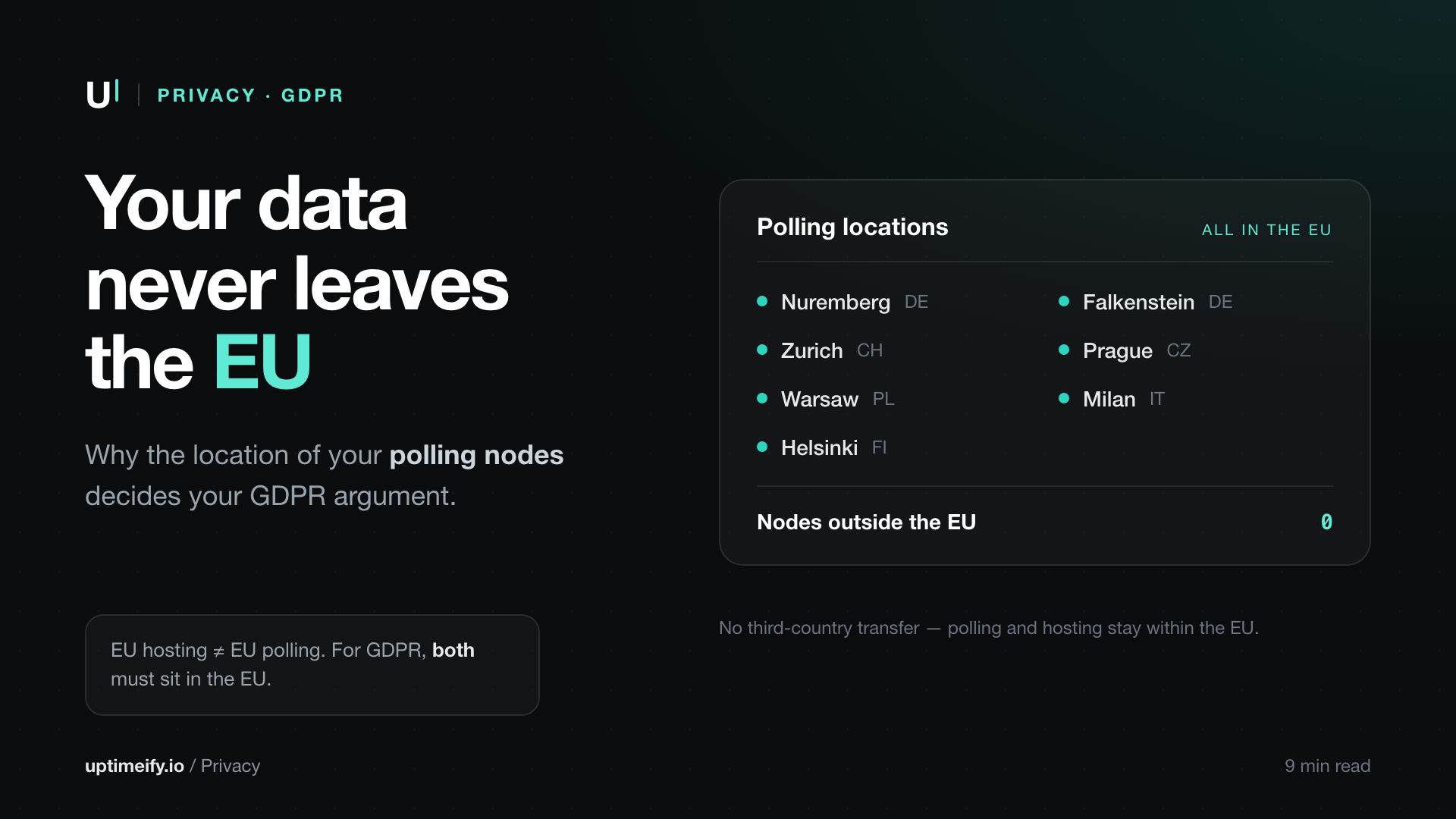
Monitoring Data in the EU: Why the Location of Your Polling Nodes Matters
Why EU polling and EU hosting simplify the GDPR case you make to your clients — and what the location of your monitoring nodes has to do with it.
How to Create an SLA Report for Clients: Uptime That Proves Your Worth
Build an SLA report that proves your uptime and justifies your retainer — month after month, under your own brand.